

Table of Contents
Introduction: Why the SaaS Product Lifecycle Matters in 2025
The SaaS industry is evolving faster than ever. With global SaaS revenue projected to exceed $300 billion in 2025, understanding the complete product lifecycle isn’t just beneficial—it’s essential for survival in an increasingly competitive market traditional software products that follow a linear path from conception to delivery, SaaS products exist in a state of continuous evolution. They require upstream work like market validation and customer onboarding, downstream activities including retention and scaling, and sometimes even pivot strategies or end-of-life planning.
As someone who has led end-to-end product delivery across CDN, SaaS, and eCommerce platforms—including launching the V5 Dashboard at 5centsCDN and building CDNToolkit from scratch—I’ve experienced firsthand how mastering each lifecycle phase creates competitive advantages that distinguish successful products from failed experiments.
This comprehensive guide breaks down every stage of the modern SaaS product lifecycle, incorporating 2025 trends, real-world examples, and actionable frameworks you can implement immediately.
Understanding the Modern SaaS Product Lifecycle
What Makes SaaS Different?
Key Characteristics:
- Cloud-based delivery – No installation, instant access from anywhere
- Subscription pricing models – Recurring revenue vs. one-time purchases
- Continuous updates– Regular feature releases without user intervention
- Multi-tenant architecture– Single instance serving multiple customers
- Customer success dependency– Retention is as important as acquisition
Two Primary SaaS Categories:
- B2B SaaS – Software built for businesses (Salesforce, HubSpot, 5centsCDN)
- B2C SaaS– Tools for consumers (Canva, Spotify, Netflix)
These characteristics fundamentally change how we approach product development, requiring integrated strategies that span the entire customer journey,
Phase 1: Ideation & Market Validation
Turning Ideas Into Viable Products
The first step of any SaaS development process is understanding exactly what you want to build—or more importantly, building something people need and are ready to pay for
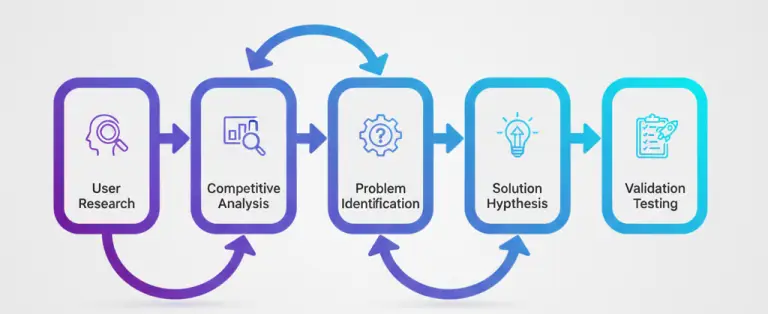
Deep User Research
- Conduct interviews, ethnographic studies, and surveys
- Map user pains, workflows, and frustrations
- Identify gaps between what users need and what currently exists
When I started developing CDNToolkit as an alternative to CDNPerf.com, I spent weeks analyzing competitor limitations, user complaints, and unmet needs in the CDN monitoring space. This research informed every design decision.
Competitive Analysis
- Identify similar tools and analyze their strengths/weaknesses
- Examine gaps in UX, performance, pricing, and integrations
- Study competitor customer reviews for pain point patterns example, while building 5centsCDN’s V5 Dashboard to compete with Cloudflare, BunnyCDN, and Fastly, we analyzed each competitor’s dashboard experience to identify where we could differentiate through superior usability and performance monitoring
Product Vision Development Product managers determine product vision through:
- Product discovery sessions with stakeholders
- Consulting subject matter experts
- Utilizing agile frameworks like Lean Startup or Product-Market Fit
- Performing market and customer research
Validation Techniques
The “Coming Soon” Button Test In existing products, adding a “coming soon” feature button that doesn’t go anywhere allows you to track interest through product analytics tools like Pendo, PostHog, or Mixpanel. This reveals which customers are drawn to new features and how they engage, providing early feedback on potential value.
Key Questions to Answer:
- Does this solve a genuine problem worth paying for?
- Is the market large enough to sustain growth?
- Can we build this with our resources and expertise?
- What’s our unique value proposition vs. competitors?
Phase 2: Design & Strategy
Transforming Vision Into Actionable Plans
With validated ideas, the next phase focuses on crafting intuitive experiences and strategic roadmaps that balance user needs with business objectives.
Core Design Activities:
Wireframing & Prototyping Using tools like Figma, Adobe XD, and Miro, transform complex requirements into visual representations:
- Low-fidelity wireframes – Basic layouts and user flows
- High-fidelity mockups– Detailed visual design with branding
- Interactive prototypes – Clickable demos for user testing
When designing CDNToolkit’s three-tier dashboard system (Super Admin, Admin, and Client views), I created complete wireframes in Figma that established design principles and information architecture before development began.
Product Roadmapping Develop feature prioritization matrices using frameworks like:
- RICE scoring – Reach, Impact, Confidence, Effort
- MoSCoW method – Must have, Should have, Could have, Won’t have
- Value vs. Complexity matrix– High value, low complexity items first
Define Product OKRs (Objectives and Key Results) Clear objectives aligned with business goals:
- Example: Increase user retention by 15% through improved dashboard usability
- Example: Reduce time-to-market by 20% through Agile implementation
GTM (Go-To-Market) StrategyCreate comprehensive launch plans including:
- Target customer segments and personas
- Positioning and messaging frameworks
- Pricing strategy and packaging tiers
- Distribution channels and partnerships
- Content marketing and SEO strategies
Design Philosophy for SaaS Success: Every element should be meticulously planned to ensure seamless execution. This phase bridges the gap between vision and reality, transforming abstract concepts into concrete development specifications
Phase 3: Development & Implementation
Building Your SaaS Product
Modern SaaS development in 2025 requires balancing rapid iteration with technical excellence..
Team Structure & Roles:
Software Development Team:
- QA Engineer – Quality assurance and testing protocols
- Front-end Developer – User interface implementation
- Back-end Developer – Server logic, databases, APIs
- DevOps Engineer – Infrastructure, deployment, monitoring
Product & Project Management:
- Product Manager – Strategic direction and feature prioritization
- Project Manager – Timeline coordination and resource allocation
Key Development Principles:
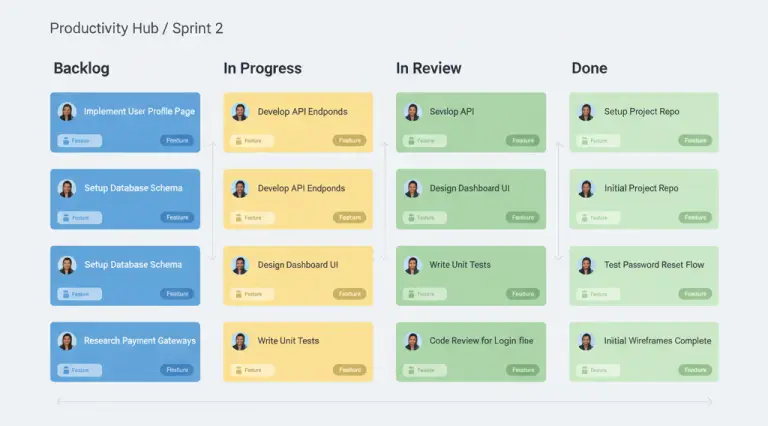
Agile & Scrum Methodology Implementing Scrum methodology can reduce time-to-market by 20% through disciplined iteration cycles. Core practices include:
- Sprint planning – 2-week development cycles with clear goals
- Daily standups – 15-minute team synchronization
- Sprint reviews – Demo completed work to stakeholders
- Retrospectives – Continuous process improvement
During the 2-year development of 5centsCDN’s V5 Dashboard, I led weekly coordination meetings where we reviewed progress, identified technical obstacles, allocated resources, and ensured design fidelity while accommodating technical constraints
Technology Stack Considerations (2025):
Frontend Frameworks:
- React & Next.js – Fast performance, server-side rendering
- Angular – Robust enterprise applications
- Vue.js – Progressive, flexible development
Backend Technologies:
- Node.js – JavaScript ecosystem consistency
- Python/Django – Rapid development, AI integration
- Go – High-performance microservices
Infrastructure:
- Cloud platforms: AWS, Google Cloud, Azure
- Containerization: Docker, Kubernetes
- CI/CD pipelines: GitHub Actions, Jenkins
Development Best Practices:
Real-Time Collaboration Using platforms like JIRA, Notion, ClickUp, Trello, and Basecamp for project coordination ensures transparent communication across distributed teams.
Quality Assurance Integration Rather than treating QA as an afterthought, integrate testing throughout development:
- Unit tests for individual components
- Integration tests for system interactions
- End-to-end tests for complete user flows
- Performance testing for load handling
When testing 5centsCDN’s V5 Dashboard across 10+ modules (HTTP Pull, HTTP Push, VOD, Traffic Director, SimpleDNS, Encoding, Video Manager), I systematically documented bugs on Userback with screenshots and severity ratings, ensuring quick resolution cycles.
Phase 4: Launch & Market Entry
Strategic Product Release
Launching a SaaS product requires more coordination than simply “flipping a switch.” Successful 2025 launches integrate phased rollouts, user adoption campaigns, and continuous feedback loops.
Launch Strategy Components:
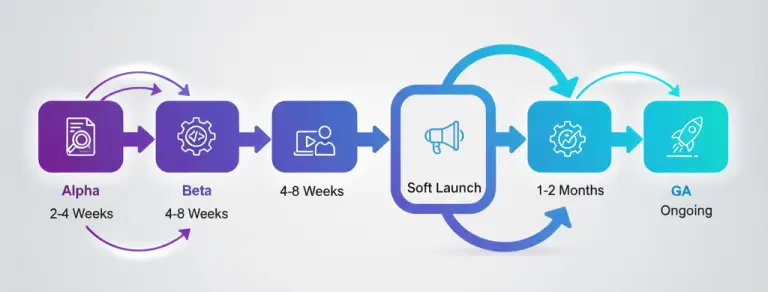
Phased Rollout Approach Rather than risky big-bang launches, implement strategic phases:
- Alpha Testing – Internal team testing to catch critical bugs
- Beta Launch – Limited release to select power users for feedback
- Soft Launch – Gradual expansion to specific customer segments
- General Availability – Full public release with marketing push This approach minimizes risk while gathering valuable user feedback that informs final adjustments.
User Onboarding Excellence First impressions matter enormously in SaaS. Effective onboarding includes:
- Interactive product tours highlighting key features
- Progress checklists showing completion milestones
- Contextual tooltips explaining complex functionality
- Quick-win features users can activate immediately
- Video tutorials and documentation library
Marketing Team Coordination: The marketing team develops comprehensive strategies including:
- Content marketing and SEO optimization
- Email campaigns to existing prospect lists
- Social media announcements and engagement
- Product Hunt or similar platform launches
- PR outreach and press release distribution.
Team Enablement effective sales strategies including:
- Product demo scripts and presentation decks
- ROI calculators demonstrating value proposition
- Case studies and social proof materials
- Pricing comparison sheets vs. competitors
Launch Metrics to Track:
- Sign-up conversion rates
- Activation rates (users completing key actions)
- Time-to-value (how quickly users get results)
- Early retention indicators (7-day, 30-day)
- Customer acquisition cost (CAC)
When launching CDNToolkit, coordinating the 4-person team through phased release with beta testing ensured we caught critical issues before general availability.
Phase 5: Growth & Optimization
Scaling Your SaaS Product
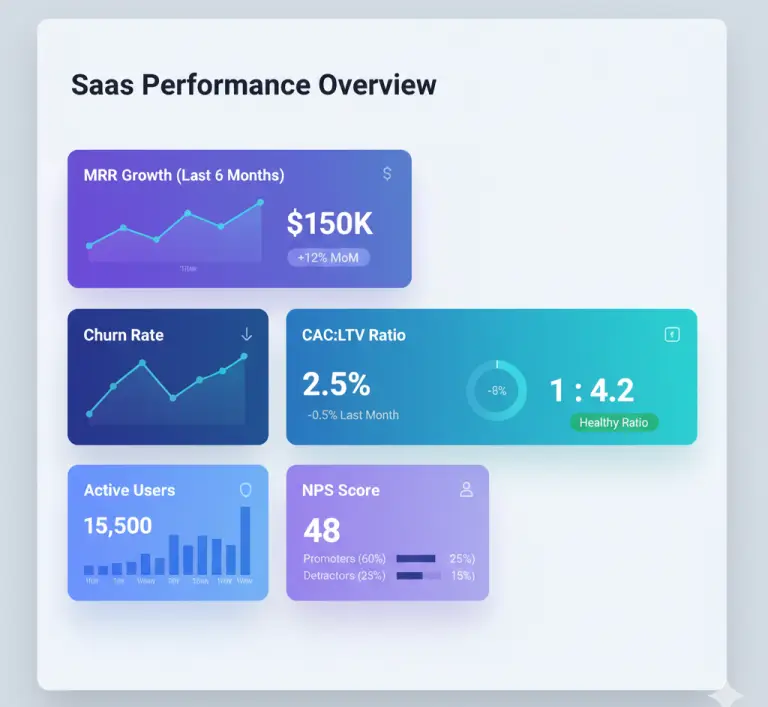
After successful launch, the focus shifts to sustainable growth through data-driven optimization and strategic expansion.
Analytics & Performance Monitoring:
Essential Analytics Tools (2025):
- Google Analytics 4 (GA4)– Website traffic and user behavior
- PostHog – Product analytics and feature usage
- Mixpanel – Event tracking and funnel analysis
- Microsoft Clarity – Session recordings and heatmaps
Key Metrics to Monitor:
Acquisition Metrics:
- Website traffic and conversion rates
- Lead generation and demo bookings
- CAC (Customer Acquisition Cost)
- Viral coefficient and referral rates
Activation Metrics:
- Onboarding completion rates
- Time to first value
- Feature adoption rates
- User engagement scores
Retention Metrics:
- Churn rate (monthly and annual)
- Customer lifetime value (CLV)
- Net Promoter Score (NPS)
- Product-market fit indicators
Revenue Metrics:
- Monthly Recurring Revenue (MRR)
- Annual Recurring Revenue (ARR)
- Average Revenue Per User (ARPU)
- Expansion revenue from upsells
Optimization Strategies:
Continuous Feature Development Prioritize and manage delivery of user-requested features based on:
- Feature request volume and voting
- Strategic alignment with product vision
- Development effort vs. expected impact
- Competitive differentiation opportunities
At 5centsCDN, delivering 10+ client-requested features increased weekly active sessions by 10%, demonstrating the impact of responsive product development.
Usability Improvements Systematic testing and iteration drive measurable improvements:
- A/B testing different UI variations
- User session analysis identifying friction points
- Accessibility audits ensuring inclusive design
- Performance optimization reducing load times
Improving 5centsCDN’s dashboard usability scores from 3.8 to 4.5 through iterative testing resulted in a 15% increase in user retention.
Customer Success OperationsBuilding customer success programs includes:
- Proactive check-ins with at-risk accounts
- Health score monitoring and intervention
- Educational webinars and training sessions
- Community building and user forums
Growth Tactics for 2025:
Product-Led Growth (PLG)
- Freemium models with clear upgrade paths
- Self-service onboarding requiring no sales interaction
- Viral features encouraging user invitations
- In-app upgrade prompts at value moments
Content Marketing & SEO Building authority through valuable content:
- Long-form guides solving customer problems
- Case studies demonstrating success stories
- Video tutorials and webinar series
- Technical documentation and API references
Partnership & Integration Strategy
- Marketplace listings (Shopify, WordPress, Zapier)
- Native integrations with complementary tools
- Co-marketing opportunities with partners
- Referral and affiliate programs
Phase 6: Maturity & Innovation
Sustaining Long-Term Success
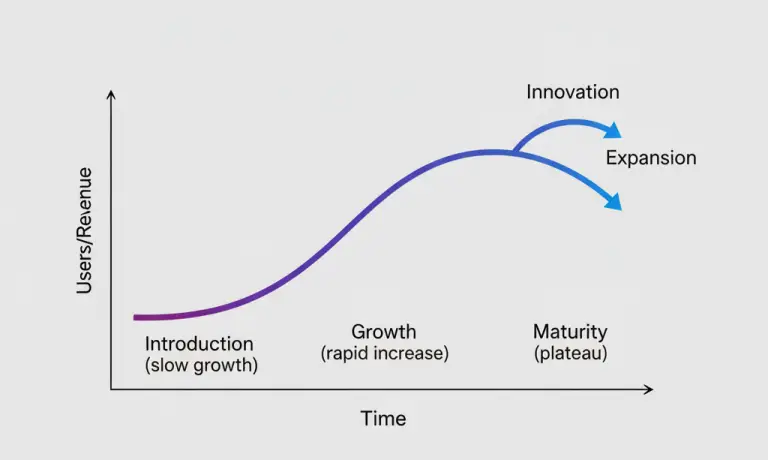
As products mature, preventing stagnation requires strategic innovation while maintaining core value propositions.
Challenges in Maturity Phase:
Market Saturation As competitors emerge and markets mature:
- Differentiation becomes increasingly difficult
- Price competition intensifies
- Customer expectations continuously rise
- Innovation cycles accelerate
Customer Expectations Evolution Users who loved your product initially now expect:
- Regular feature updates and improvements
- Integration with emerging platforms
- Enhanced performance and reliability
- Personalization and customization options
Strategic Responses:
Continuous Innovation
- Dedicated R&D for next-generation features
- Beta programs testing experimental functionality
- Acquisition of complementary products/teams
- Platform expansion into adjacent markets
Platform Approach Transforming products into platforms:
- API access for third-party developers
- Marketplace for extensions and add-ons
- White-label options for enterprise clients
- Developer relations and ecosystem building
Customer Retention FocusMaintaining existing customers costs 5-7x less than acquiring new ones:
- Loyalty programs rewarding long-term users
- Exclusive features for tenured customers
- Advisory boards giving voice to key accounts
- Community events and user conferences
Competitive Positioning Evolution Competing against industry giants like Cloudflare, BunnyCDN, and Fastly requires continuous differentiation through superior usability, specialized features, or exceptional customer service.
Phase 7: Pivot, Evolution, or End-of-Life
Making Strategic Transitions
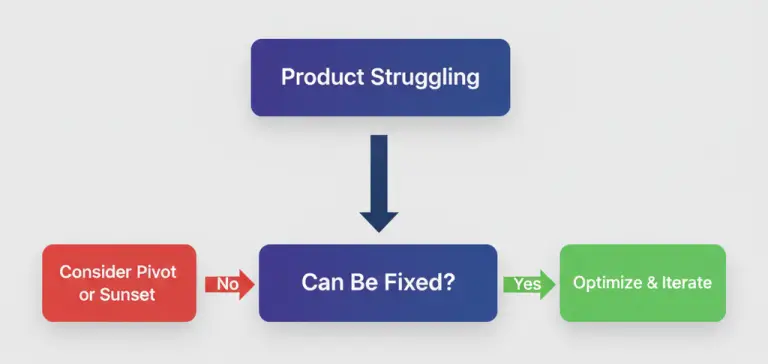
Not every product follows a linear success trajectory. Sometimes strategic pivots or graceful shutdowns are necessary decisions.
When to Consider Pivoting:
Market Signals:
- Consistently missing growth targets despite optimization
- Shrinking market size or fundamental market shifts
- Emergence of disruptive competitors or technologies
- Changing regulatory landscape affecting viability
Customer Feedback Patterns:
- Requests clustering around different use cases than intended
- High activation but low retention indicating misalignment
- Feature usage data contradicting original assumptions
- Competitive losses to products solving adjacent problems
Famous SaaS Pivots:
- Slack – Started as gaming company internal tool
- Instagram – Pivoted from location-based check-in app
- Twitter – Evolved from podcasting platform Odeo
- Shopify – Originally sold snowboarding equipment
Pivot Strategies:
Feature Pivot Focus on the most successful feature as the core product, retiring or de-emphasizing others.
Customer Segment Pivot Target a different customer segment better aligned with product capabilities.
Platform Pivot Transform from standalone product to platform supporting third-party developers.
Business Model Pivot Change monetization approach (e.g., freemium to enterprise-only).
End-of-Life Considerations:When products are no longer viable, responsible wind-down includes:
- Clear communicationwith customers about timeline
- Data export toolsenabling migration to alternatives
- Prorated refundsfor subscription periods not served
- Recommendation of alternative solutions
- Archival access for historical data retrieval
Handling end-of-life gracefully preserves brand reputation and maintains customer relationships for future ventures.
Essential Tools for Each Lifecycle Phase
Building Your SaaS Tech Stack
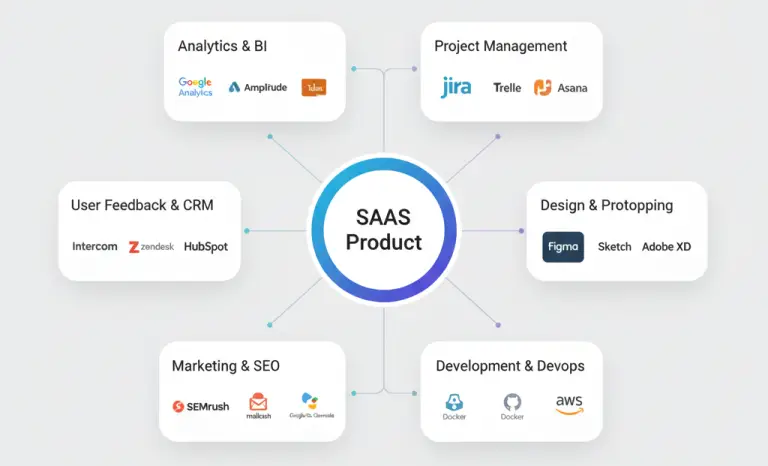
Success across the product lifecycle requires the right tools supporting each phase. Here’s a comprehensive breakdown:
Ideation & Research Phase:
- User Research: UserTesting, Hotjar, Maze
- Competitive Analysis:SimilarWeb, Ahrefs, SEMrush
- Survey Tools: Typeform, SurveyMonkey, Google Forms
- Market Research: Gartner, CB Insights, Product Hunt
Design & Prototyping Phase:
- Wireframing: Figma, Adobe XD, Sketch
- Prototyping: InVision, Marvel, Framer
- Collaboration: Miro, FigJam, Balsamiq
- Design Systems: Storybook, Figma, Zeroheight
Development Phase:
- Project Management:JIRA, Notion, ClickUp, Trello, Monday.com
- Communication: Slack, Microsoft Teams, Basecamp
- Version Control:GitHub, GitLab, Bitbucket
- CI/CD:Jenkins, CircleCI, GitHub Actions
Testing & QA Phase:
- Bug Tracking:Userback, BugHerd, Jira
- Test Automation: Selenium, Cypress, Jest
- Performance: GTmetrix, WebPageTest, Lighthouse
- Security:OWASP ZAP, Snyk, Open Appsec, Burp Suite
Launch & Marketing Phase:
- Email Marketing: Mailchimp, SendGrid, Customer.io
- Analytics:GA4, PostHog, MSClarity, Mixpanel, Amplitude
- SEO: Ahrefs, SEMrush, Google Search Console
- Social Media:Buffer, Hootsuite, Later
Growth & Optimization Phase:
- A/B Testing:Optimizely, VWO, Google Optimize
- Session Recording: Microsoft Clarity, FullStory, Hotjar
- Customer Success: Intercom, Zendesk, HubSpot
- Product Analytics: PostHog, Pendo, Heap
Financial Operations Phase:
- Payment Processing: Stripe, PayPal, Instamojo
- Billing Management: Chargebee, Recurly, Zuora
- Invoicing:QuickBooks, FreshBooks, Wave
The right tools amplify productivity, but remember: tools enable processes, they don’t create them. Build solid processes first, then find tools that support your workflows.
Common Pitfalls & How to Avoid Them
Learning from Frequent Mistakes
Having managed multiple SaaS products through complete lifecycles, here are critical mistakes to avoid:
1. Building Before Validating
- Mistake: Spending months building features nobody wants
- Solution: Validate with customer interviews, landing pages, or “coming soon” buttons before development Ignoring Competitive Analysis
- Mistake: Assuming your idea is unique without researching competitors
- Solution: Study competitors not for feature wars, but to understand unmet needs and differentiation opportunities Poor Cross-Functional Communication
- Mistake: Design and development working in silos without coordination
- Solution: Weekly synchronization meetings, shared documentation, and collaborative tools like Basecamp and Slack
4. Insufficient QA Testing
- Mistake: Rushing to launch without comprehensive testing
- Solution: Systematic testing across all modules with documented bug tracking and regression testing
5. Launching Without GTM Strategy
- Mistake: Building great products but failing to reach target customers
- Solution: Develop comprehensive go-to-market plans including positioning, messaging, content, and distribution channels before launch Neglecting User Onboarding
- Mistake: Expecting users to figure out your product independently
- Solution:Design intentional onboarding flows with progressive disclosure and quick wins Vanity Metrics Over Actionable Data
- Mistake: Celebrating user signups while ignoring activation and retention
- Solution: Focus on metrics that predict revenue: activation rates, retention cohorts, and expansion revenue
8. Feature Bloat Without Focus
- Mistake: Adding features requested by the loudest customers
- Solution: Prioritize using frameworks like RICE scoring aligned with strategic product vision
9. Inadequate Documentation
- Mistake: Tribal knowledge existing only in team members’ heads
- Solution: Maintain operational documentation for processes, decisions, and technical specifications
10. Ignoring Customer Feedback Loops
- Mistake: Building roadmaps in isolation without customer input
- Solution:Establish systematic feedback collection through surveys, user interviews, and feature voting platforms these pitfalls requires discipline, communication, and user-centricity—principles that successful product managers embody throughout the lifecycle.
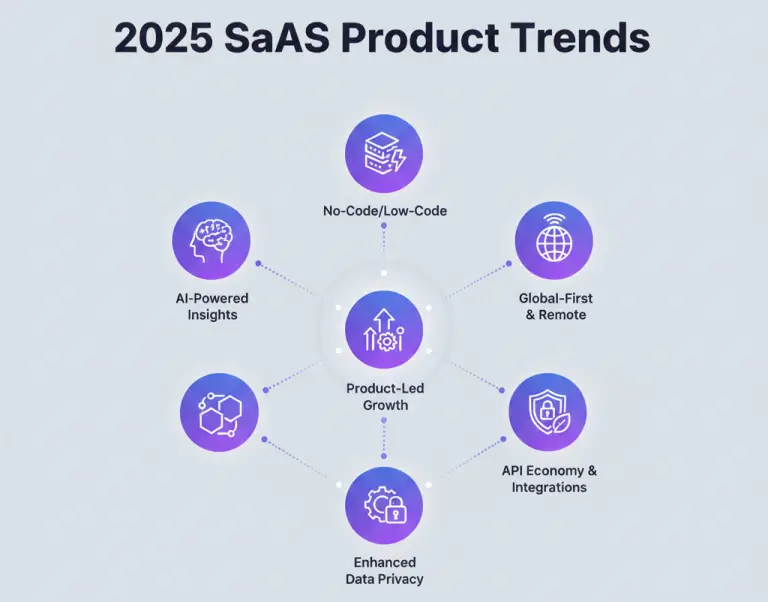
The Future of SaaS Product Development
Emerging Trends for 2025 and Beyond
The SaaS landscape continues evolving rapidly. Here are key trends shaping the future:
AI-Powered Product Development
- Automated code generation and testing
- AI-driven user behavior prediction
- Personalized product experiences at scale
- Intelligent feature recommendations
No-Code/Low-Code Integration
- Empowering non-technical users to customize
- Faster prototype development
- Democratization of product building
- Platforms like Webflow, Framer, Bubble gaining traction
Product-Led Growth Dominance
- Self-service onboarding becoming standard
- Freemium models with viral features
- In-app expansion revenue opportunities
- Reduced reliance on traditional sales
Privacy-First Analytics
- Cookieless tracking solutions
- First-party data strategies
- Privacy-compliant alternatives to GA4
- Tools like PostHog prioritizing user privacy
Micro-SaaS Opportunities
- Focused solutions for niche markets
- Small teams building profitable products
- Lower customer acquisition costs
- Specialized rather than generalized offerings
API-First Architecture
- Products designed as platforms from day one
- Extensive integration ecosystems
- Developer-focused go-to-market
- Headless SaaS enabling customization
Remote-First Development
- Globally distributed teams becoming standard
- Asynchronous collaboration tools essential
- Documentation-first communication
- Tools like Notion, Slack, and Basecamp enabling coordination
Vertical SaaS Growth
- Industry-specific solutions outperforming horizontal
- Deep domain expertise creating competitive moats
- Compliance and regulation as features
- Higher willingness to pay from specialized markets
Staying ahead requires continuous learning, experimentation, and adaptation. The most successful SaaS products in 2025 will combine these emerging trends with timeless principles of user-centricity and operational excellence.
Conclusion: Mastering the SaaS Product Lifecycle
Building successful SaaS products in 2025 requires mastering every phase of the lifecycle—from initial ideation through sustained growth and strategic evolution.
Key Takeaways:
- Validate Before Building– Market research and competitive analysis prevent wasted development effort Design Drives Experience – Intuitive wireframes and strategic roadmaps bridge vision and execution
- Agile Delivers Results– Scrum methodology and cross-functional coordination reduce time-to-market significantly
- Testing Ensures Quality– Comprehensive QA across all features prevents costly post-launch issues
- Launch Strategically– Phased rollouts with user adoption campaigns minimize risk while maximizing feedback
- Optimize Continuously – Data-driven iteration improves usability, retention, and revenue metrics
- Innovate or Stagnate– Mature products require strategic innovation to sustain competitive advantages
- Know When to Pivot– Market signals and customer feedback sometimes indicate strategic direction changes
Throughout my 6+ years managing digital products across CDN, SaaS, and eCommerce—from launching 5centsCDN’s V5 Dashboard to building CDNToolkit from scratch—I’ve learned that successful product management combines strategic thinking, operational excellence, and relentless user focus.
The lifecycle never truly ends. Each phase informs the next, creating a continuous improvement loop that distinguishes market leaders from also-rans.
What's Your Next Step?
Whether you’re launching your first SaaS product or optimizing an existing platform, applying these lifecycle principles will accelerate your journey from idea to sustainable business.
Ready to dive deeper? I regularly share insights on product management, operations optimization, and SaaS strategy. Connect with me on LinkedIn or explore my portfolio at www.zaverizwan.com to see how I’ve applied these principles to real-world products.
Have questions about specific lifecycle phases? Drop a comment below and let’s discuss how to solve your unique product challenges.